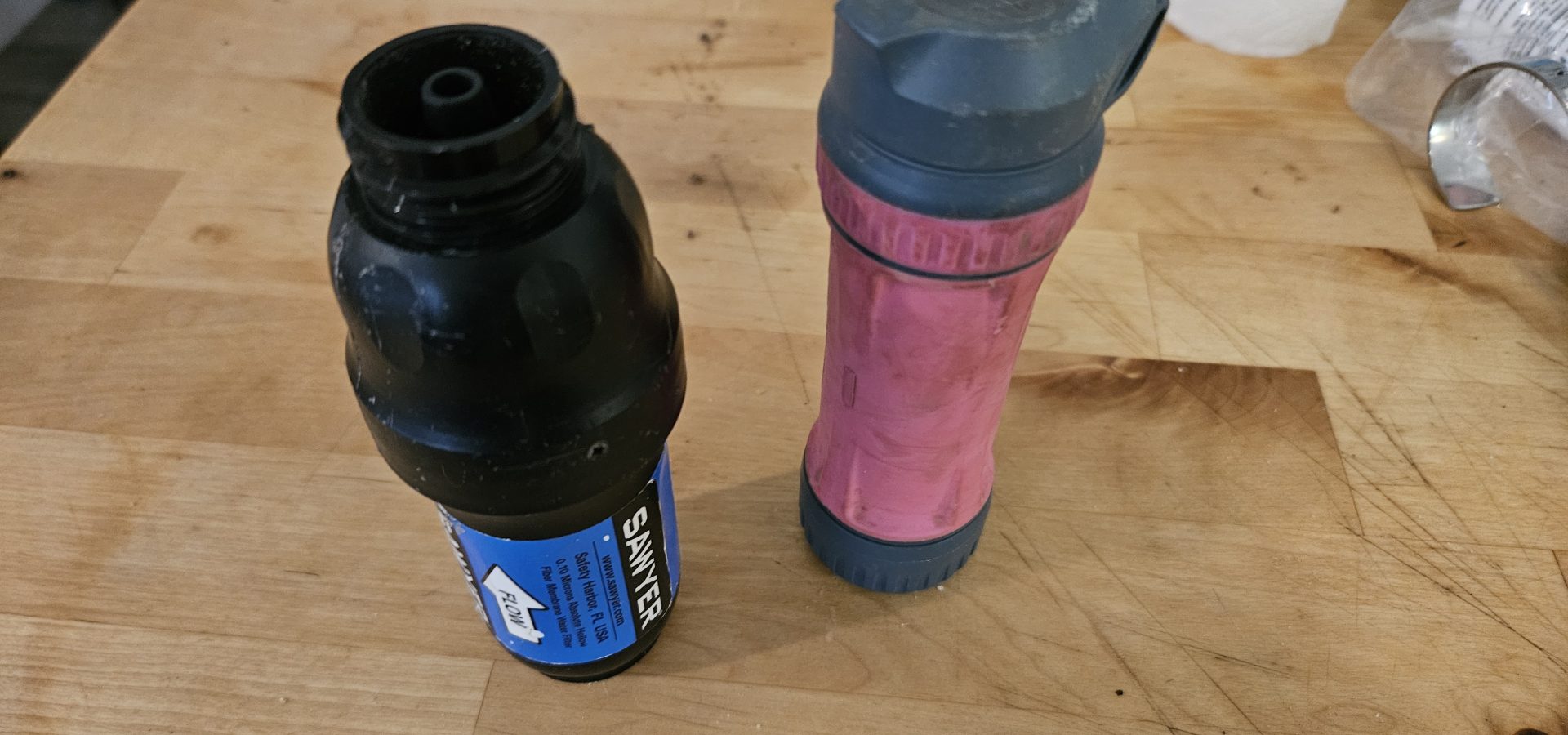
A 0.1 micron (Sawyer) hollow fiber filter probably does hold back a bit more bacteria than a 0.2 micron filter (Platy), but a single cracked fiber is likely to be more significant than the difference in pore diameter when filtering the backcountry. If you’re choosing between a Sawyer Squeeze (0.1) and a Platypus QuickDraw (0.2), I think that the Platypus is the overall better option
| Filter Name | Sawyer Squeeze Filter | Platypus QuickDraw Filter |
| Pore Size | 0.1 micron | 0.2 micron |
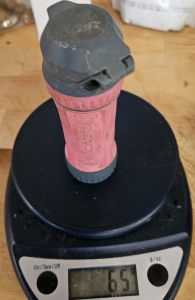
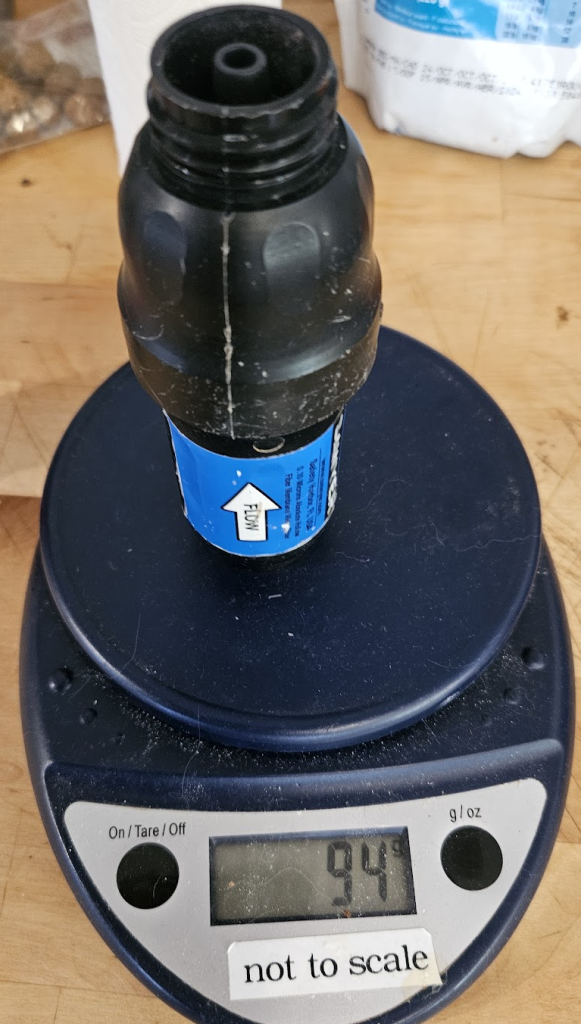
| Weight | 94 grams (after use) | 65 grams (after use with the filter cap) |
| Price | $46 | $40 |
| Marketing Claim | Removes 99.99999% of bacteria and removes 99. 9999% of protozoa. Meets all EPA & NSF guidelines. | Meets all EPA & NSF guidelines for the removal of 99.9999% of bacteria and 99.9% of protozoa. |
| Notes | Reliable, commonly used filter. Biggest issue seems to be the “O-ring” failure. I am a little suspect of their marketing claims (given lab tests around protozoa, and patent details I discuss below) | The main filter I now use. I do not recommend using the Sawyer Squeeze after having switched to the Platy. |
In general, I describe the Platypus QuickDraw as a better filter. It’s like Platypus looked at the Sawyer, determined where the problems were, and fixed them all! This includes the O-ring problem, back flushing, being able to easily sleep with the filter, and field integrity tests.
Some people say, “but the Sawyer is better at filtering because it is a 0.1 micron filter, rather than a 0.2 micron filter.” However, both filters remove the main waterborne illnesses: crypto, ecoli, and bacteria, while doing little-to-nothing to protect against viruses.
So how do these puppies compare?
I’ve gone ahead and reviewed some peer-reviewed literature (science!) about membrane filters like these, and also scoured the patent databases for both companies to see what is discernable about each brand’s technology and their marketing claims. References are placed throughout.
What does a “0.1 micron” get you?
A hollow fiber doesn’t have just one, uniform pore size (although Sawyer is suggesting there are NO pores above 0.1 micron…). Each filter contains a statistical distribution of different porse sizes based on the manufacturing technology. There will be some very small pores, and some bigger pore sizes, with some sizes being more likely than others. The rare, “big” pores are the main things that let bacteria and other things through.
Researchers measure this with capillary flow porometry: you wet the membrane and push gas through it. The pressure where the first bubble breaks through (the bubble point) tells you the largest pore [1].
That means that the ratings on the box aren;t actual measurements. All a 0.2 micron rating means is that a membrane passed a test using the Brevundimonas diminuta bacteria, which is a small test bacterium. Real bacteria found in water sources are different from the test bacteria. Due to bacteria geometry, some of these bacteria will get through filters that the test organism doesn’t go through.
Neither Sawyer nor Platypus has published porometry data on their current filters (at least not that I could find). The closest hint of thing I found is the patent record, and it doesn’t completely line up with the current marketing claims that Sawyer makes.
Bacteria: smaller pore sizes are generally better, but bacteria that pass through may not be viable
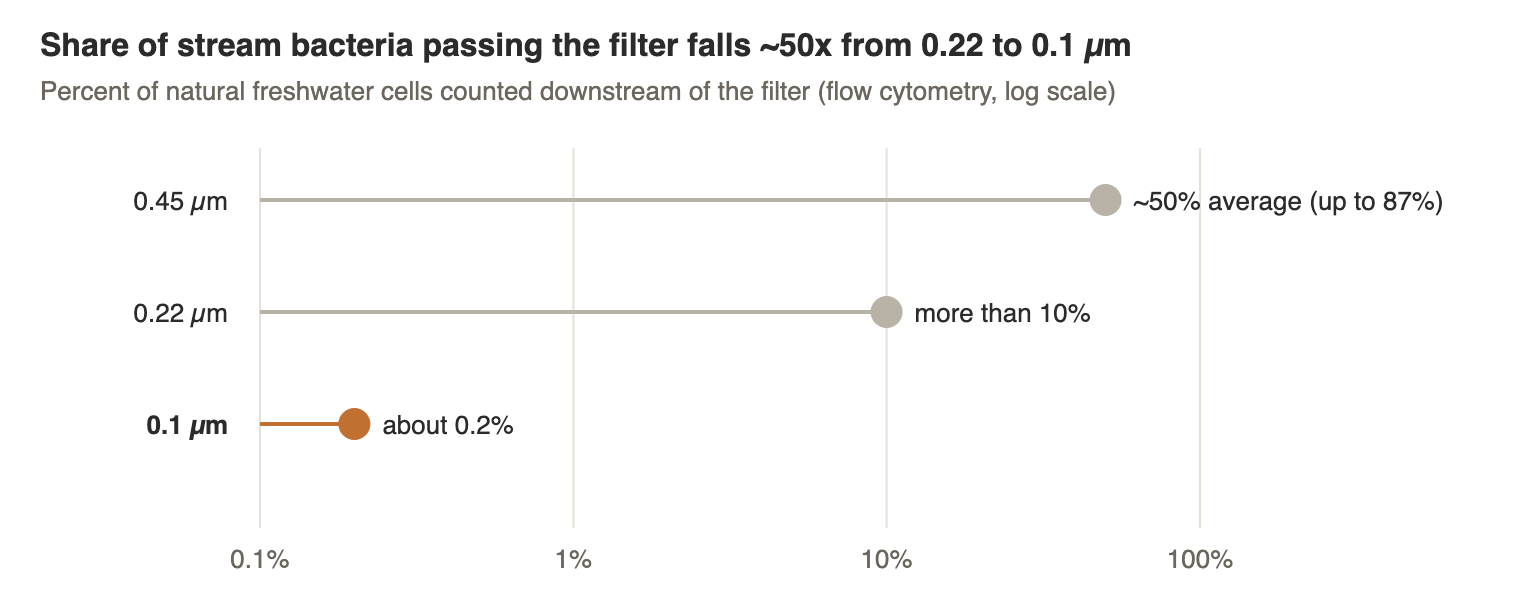
Wang and colleagues measured the concentration of natural freshwater bacteria that made it through filters with various poristy. A significant share of the starting bacteria passed through the 0.45 micron filter (up to 87%). Significantly less passed through the 0.22 micron filters (up to 5%), and a very small fraction passed through the 0.1 micron filters [2]. They then enriched the water sample (increased overall concentration), and re-measured in the 0.22 micron and 0.1 micron filters. Up to 10-ish% of the concetrated stream made it through the 0.22 micron filter, and up to 8% made it through the 0.1 micron filter.
They conducted follow-up research and found that bacteria shape and flexibility mattered more than bacteria size: a thin, spiral-shaped stream bacterium (Hylemonella) got through best, while lab E. coli passed at under 0.2% in the 0.2 micron filter, and was not dectable in the 0.1 micron filter [3].
Ghayeni and colleagues saw the same pattern in wastewater: membranes with pore sizes significantly smaller than 0.2 micron prevented up to 100x more bacteria from passing through than filters with measured pore sizes ~0.2 microns [4]. However, the authors note that of the bacteria that did pass through the 0.2 micron filter, “None of the organisms… were subsequently capable of growth in laboratory media, either in suspension or on agar plates. If viability did somehow correlate with physical size of cells, it would be possible that filtration is simply ‘selecting’ non-cultureable bacteria due to their smaller size.”
Protozoa and Virus Filtration Efficacy
For Giardia and Cryptosporidium, filters with pore size ratings between 0.1 and 0.2 microns doesn’t appear to matter. Both perform similarly, in which Giardia and Crypto were not detected. Jacangelo’s group tested microfiltration membranes from 0.08 to 0.22 micron and found no cysts in the filtrate from intact hollow fibers at the detection limit for their methods [7].
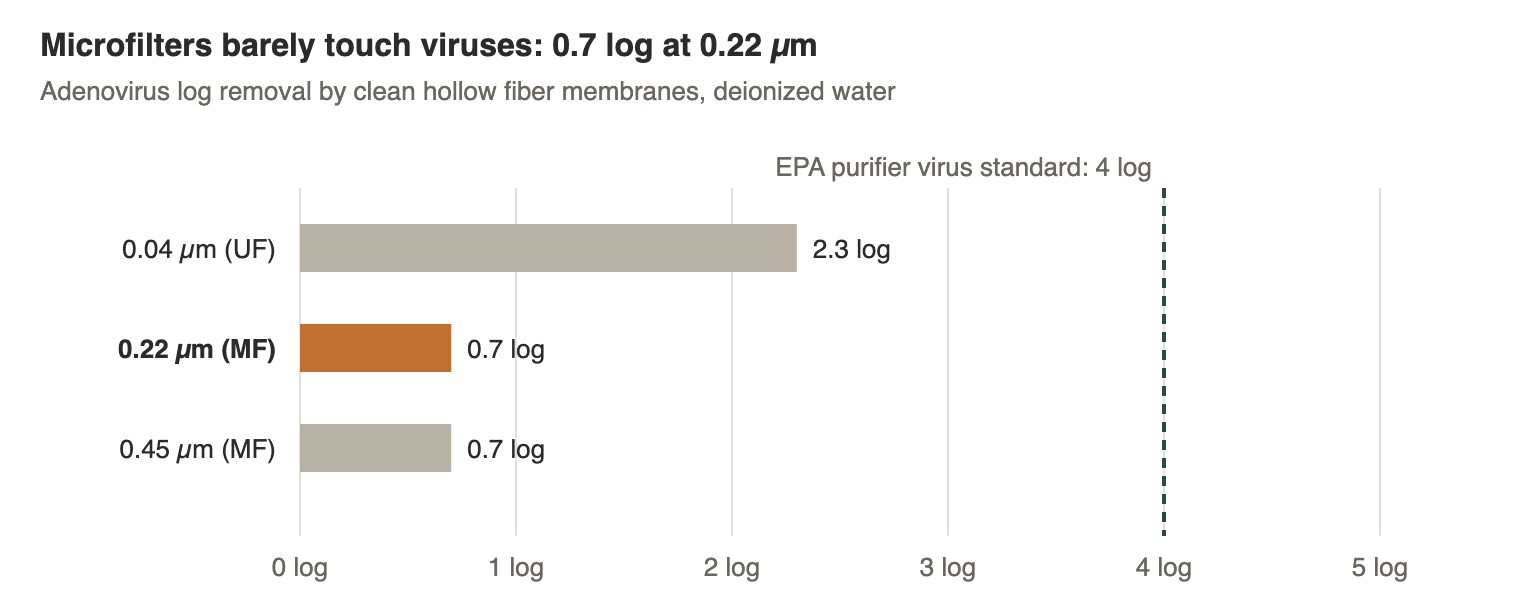
Viruses are much, much smaller than the pore sizes of either the Sawyer or the Platypus filter. In clean water, a 0.22 micron hollow fiber removed only 0.7 log of adenovirus, the same as a 0.45 micron filter. For filters with measured pore sizes of 0.04 micron, the filter still performed significantly below the level that EPA uses for assessing virus filtration efficacy [5]. A 0.1 micron fiber is unlikely to perform meaningfully better than a 0.2 micron filter when it comes to virus removal.
Efficacy of Sawyer Filters in the Field
There was an academic study that looked at the efficacy of Sawyer filters in real world use. Sawyer filters were deployed to over 200 households in 6 rural Honduras communities, and the efficacy of filtration were measured after use. The researchers collected 6 of the deployed Sawyer filters, and found that these filters had catastrophically failed within 2 years of household use.
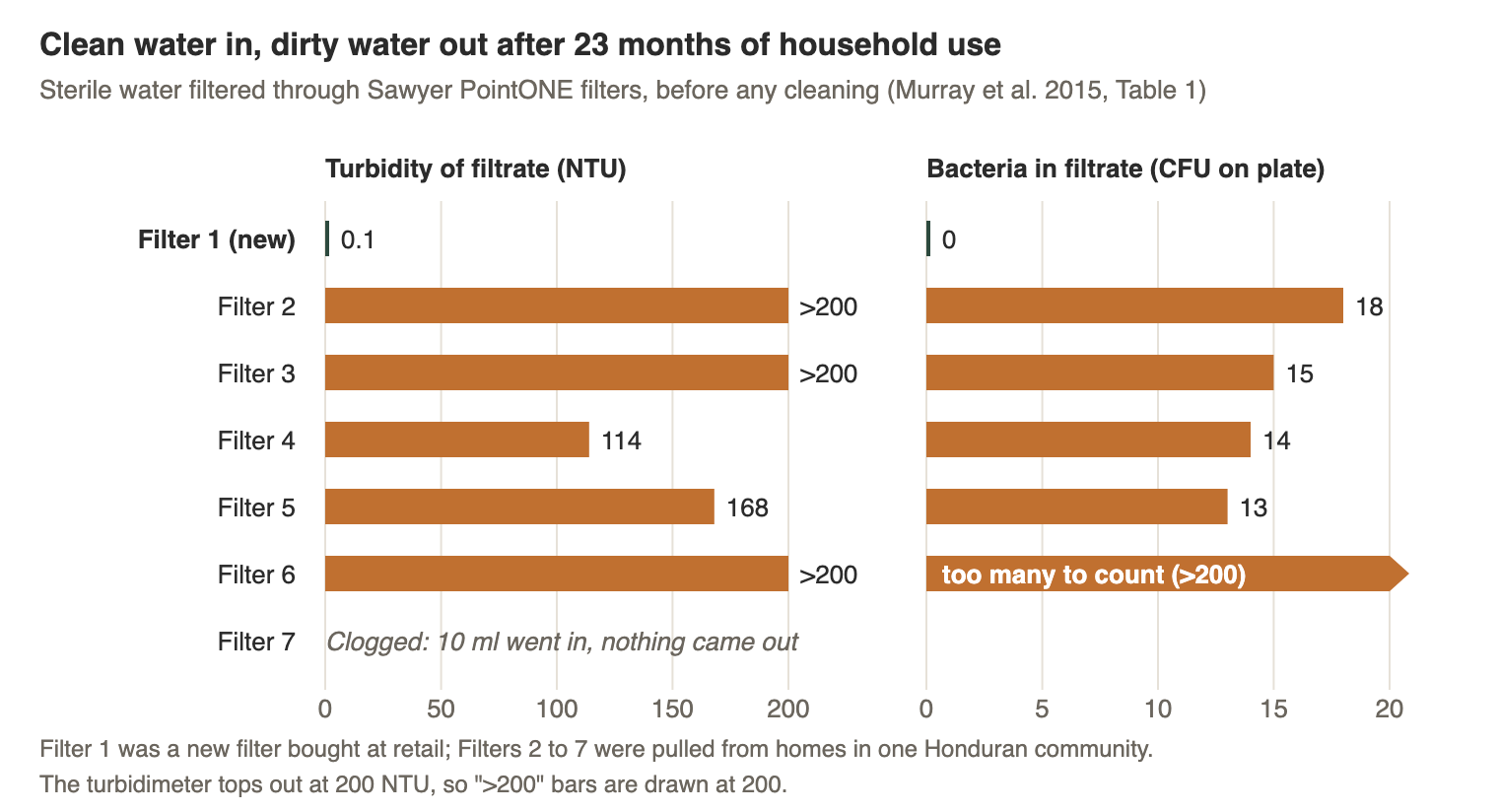
Murray and colleagues measured the filtration efficacy of filters across 6 communities after 23 months of use, and found the filters to be significantly fouled by metal oxides, organics, and biofilm. They could also see burst fibers upon close visual inspection [9]. In another study, Heylen and colleagues showed fouling changed fiber break force and stretch of the filter within 200 hours in four commercial household hollow fiber filters, even before the water quality began to significantly degrade [13].
Broken fibers matter more than pore size
A hollow fiber filter is a collection of tiny little tubes. If one of these tubes cracks, dirty water bypasses the filter, exposting you to bacterial load.
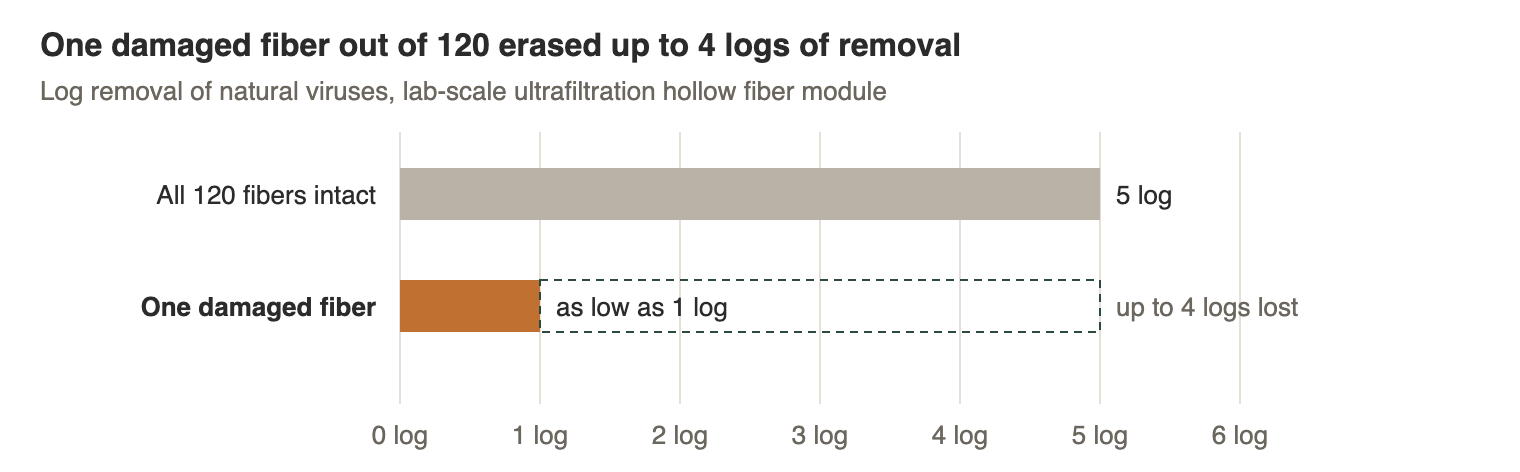
Gowda et al (2025). explored the efficacy of filtration under degredation conditions. They used a 120-fiber module (reasonably comparable to a Platypus or Sawyer squeeze filter ). One break in your filter could plausibly result in several orders of magnitude more bacterial load when filtering. This is significantly more than any difference in filtration efficacy you might get based on 0.2 micron versus 0.1 micron filters.
Fibers are known to break in these filters (e.g. Honduras study). These filters often get exposed to freezing temperature, and get beat up from moving around or dropped on the ground by backpackers. Similar types of filters rated for industrial applications see 1 to 10 fiber failures per million fibers per year [11]. Stress concentrates where fibers enter the potting resin, and in one comparison, symmetric polyethylene fibers were the weakest tested [12].
Due to the reasonable possibility of failure, the Platypus QuickDraw’s field integrity test is a significant advantage compared to the Sawyer. Sawyer clearly states there is no integrity test for their product. With the Platypus, you can find out if the filter membranes are still functional after a drop or an unexpectedly cold night. Sawyer filters do not have an easy or reliable way to conduct an integrity test. You can try squeezing air through a wet Sawyer, but without a clear way to see bubbles coming out of the membrane, “it felt like it held air” isn’t a reliable diagnostic, and the company specifically warns against this.
How the integrity test works for QuickDraws
The integrity test:
- Filter a liter of water to ensure the filter is saturated with water.
- Re-fill the bottle half-way, and press to try and push air through the filter (a working filter really won’t let air go through).
- A steady stream of air bubbles should not come out of the filter. If there is a steady stream, the filter is compromised.
Here’s Platypus’s video of the test. When the filter is adequately wetted, air cannot pass through until the pressure is absurdly high. The water’s surface tension across the tiny pores forms a barrier, the same bubble point physics researchers use to measure the largest pore (see above).
My old, reliable QuickDraw finally bit the dust in 2024, so I decided to grab a new one from REI. I returned 4 to REI, and another one to Amazon. All 5 of these newly purchased filters failed the integrity test out of the box: an endless, continuous stream of air bubbles filling the membrane opening, after I had already filtered 4 liters through it. The filter should not have air bubbles coming through, period, let alone something that looks like a frothing machine.
I took this to r/Ultralight, and a few skeptical comments made me test, and test again. After running way, way more water through the filter than the integrity test says is necessary, I no longer believe the filters I bought had a manufacturer defect. The first 2-3 gallons through would let air pass very easily. Probably around gallon 4 or so, the stream of air bubbles significantly shut off. By 5 gallons, I was not seeing any air bubbles through the filter when performing an integrity test, and I couldn’t squeeze hard enough to get air through without breaking the water bladder.
What I do believe is faulty is the manufacturer’s integrity test procedure for new filters. The membrane is not adequately wetted out until significant water has been passed through. Run at least 5+ gallons through a new QuickDraw before you trust the test. If you’re getting fewer air bubbles and having a harder time pushing air through as you filter more water, the filter is likely working, and was just not wetted enough earlier. I don’t encourage testing the filters brand new, as they are likely to be working out the factory gate.
Sleeping, back flushing, and O-rings
The platypus filter design is more conducive for sleeping with in your sleeping bag. The cap screws on over the dirty-water end, you close the flip cap on the clean end, and you just toss it in with you. The Sawyer requires a water bottle cap and plastic bag (which will undoubtedly tear and leak over time). It’s more of a pain in the ass. Also, the platypus is lighter, weighing in at around 2.5 oz vs 3.5 oz for the Sawyer Squeeze.
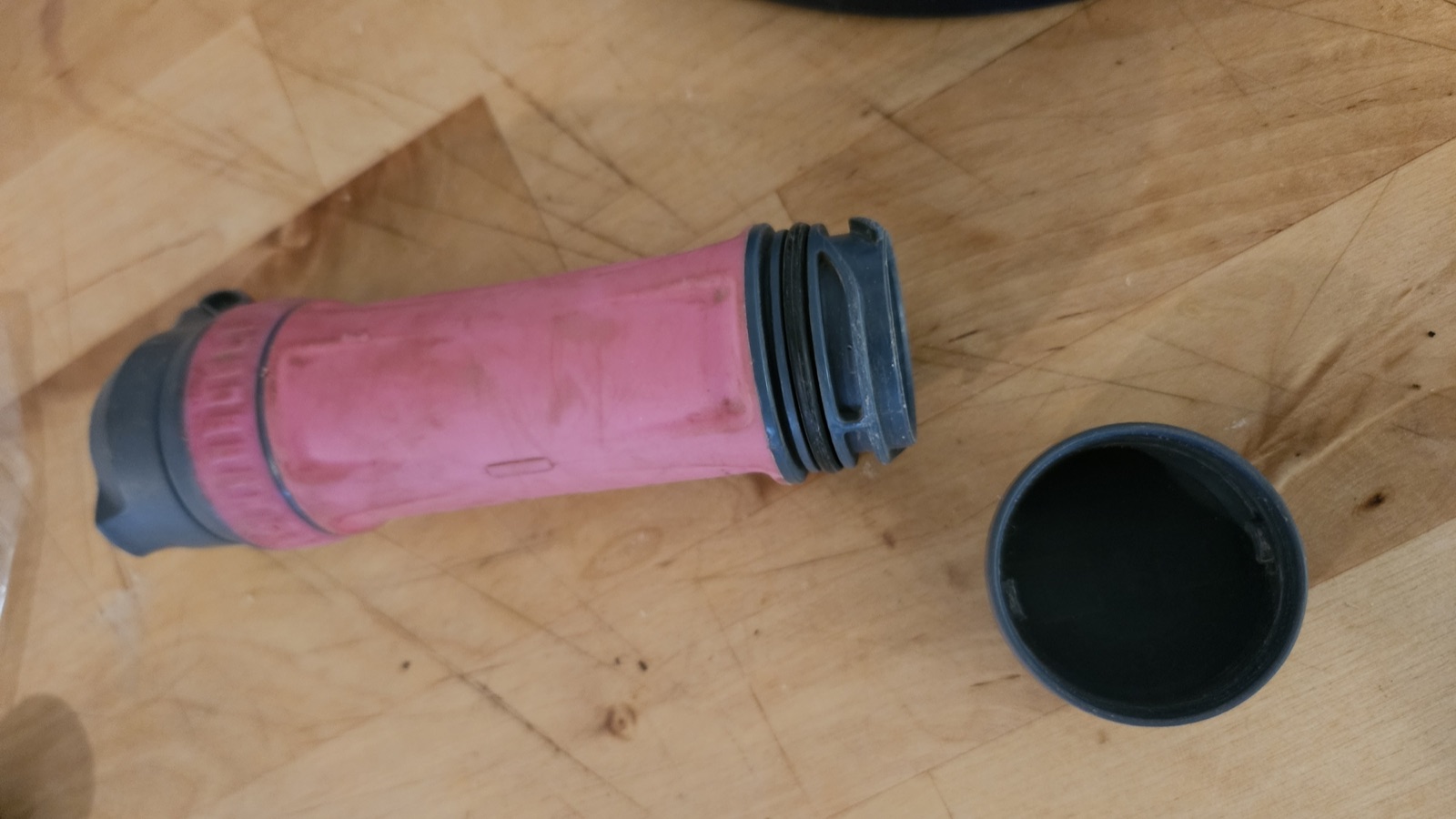
The platypus can also be back flushed more reliably than the Sawyer. This keeps the flow rate higher (the QuickDraw already flows faster out of the box), and filtering frustration is greatly reduced. My old QuickDraw worked for 1500 miles, and only failed because it rolled off the top of a shelf onto concrete. My Sawyers usually got tossed when they got slow (around 1000 miles of use), or when I thought they froze.
Finally, the platypus does not suffer from the Sawyer O-ring issue. You can’t lose an O-ring and be unable to filter (happens frequently enough with Sawyers). Because there’s not the O-ring issue, the platypus also creates better seals with Smartwater bottles, and you reduce the risk of dripping dirty water into your clean water bottle.
Using the Platypus to filter a mud hole in the Grand Canyon
On the Arizona Trail in 2023, four of us were down to half a liter of water and half a liter of urine, and about to night hike 6 hours back to Phantom Creek. We contoured into a dried-up slot canyon and our headlamps reflected some muddy footprints. Ecstatic at the realization that there were footprints in mud, we frantically dug a 1-foot hole in the ground that miraculously began to fill with water. Over the next 4-5 hours we filtered 22 liters of red mud from the hole, enough to rehydrate, and enough to begin route finding in the morning.

Of the two Sawyer Squeezes and one Platypus QuickDraw we used on that mud, only the Platy was recovered with a vinegar soak and back flushing.
What the patents show
The Sawyer fiber traces back to Innova Pure Water. In 2003 Sawyer licensed Innova’s hollow fiber bottle patent [P1, P2]. Innova’s application describes fibers with a mean pore size around 0.15 micron and a range of 0.02 to 0.4, and claims 0.1 to 0.3 micron [P2]. The license spec promised only about 4-log protozoa and 6-log bacteria removal, with a 75 gallon life [P1].
John T. Smith, a co-inventor on that Innova application, is the inventor on Sawyer’s later patents: a faucet filter attachment with backwash-by-reversal [P3] and two design patents for filter housings [P4, P5]. The faucet patent cites Innova’s “biological filter on a tube” application as prior art [P6]. None of Sawyer’s own patents disclose fiber material, pore distribution or wall thickness. If the current fiber is built on the technology art reflected in the Innova patent, then it is unlikely that the current iteration of Sawyers are filters with “no pore larger than 0.1 micron.” It’s not clear to me if manufacturing processes are significantly different from this patent, but it makes me view the 0.1 micron marketing claim are questionable. Murray et al. (2017), go far as to say, “when comparedto household performance of other commercially-produced membrane filters used for six months to two years, these [Sawyer] filter results are consistent with the Nerox™ (A-Aqua, Oppegaard, Norway) flat-sheet 0.28 μm membrane… However, they are lower than the household performance of the 0.02 μm hollow fiber membrane Lifestraw”.
Cascade Designs (Platypus, MSR) filed a portable hollow fiber filter application in 2009 [P7]. It describes hydrophilic polysulfone fibers mixed with hydrophobic polyethylene fibers that bleed off air, about 0.5 mm outside diameter with 0.1 mm walls. It cites 1.75 L/min in gravity mode, the same figure Platypus lists for the QuickDraw today.
| Sawyer lineage | Cascade Designs lineage | |
|---|---|---|
| Fiber polymer | Not disclosed | Polysulfone, plus polyethylene air-bleed fibers [P7] |
| Pore size in patents | Mean ~0.15 µm, range 0.02 to 0.4 µm [P2] | Not disclosed |
| Fiber size | Not disclosed | ~0.5 mm OD, 0.1 mm wall [P7] |
| Field integrity test | None | Yes, on current QuickDraw |
| Marketed rating | 0.1 µm “absolute” | 0.2 µm |
Wall thickness and squeeze pressure
Bacteria aren’t hard spheres. Helling et al. built polyethersulfone membranes with tuned retention and found Gram-negative bacteria passed more easily as pressure went up, because they deform and squeeze through pores [6]. Stiffer Gram-positive bacteria needed much higher pressure. E. coli, Salmonella and Campylobacter are all Gram-negative.
Sawyer markets thicker walls and a smaller bore, and the Squeeze flows slower than the Platy, with a marketing specification of only about 1.7 L/min compared to the QuickDraw with about 3 L/min. Slower flux per unit of membrane may mean fewer deformable cells that are forced through. However, Ghayeni et al. [4] did not find that bacteria cells that passed through either the 0.1 or 0.2 micron membranes to be viable when they attempted to culture them.
Filter Break Down
- Either filter is fine for Giardia and Crypto. Both pore sizes hit the detection limit in lab work, so are similarly effective.
- For bacteria, the Sawyer may reduce bacteria loads more. This requires the the fibers to be fully intact, and for marketing claims to align with actual specification (appears questionable)
- Neither stops viruses. Downstream of people or livestock, or traveling abroad, neither filter will remove viruses from water. This requires the addition of chlorine dioxide (Aquamira).
- Protect the fibers. Keep the filter in your sleeping bag on cold nights. After a drop or a possible freeze, test it if you can (QuickDraw) or replace it (Sawyer).
- Wet a new QuickDraw before testing it. Run 5+ gallons through a new filter before you trust the integrity test.
- Backflush on schedule and don’t trust a filter that suddenly flows much faster.
References
Journal articles
- Hernández A, Calvo JI, Prádanos P, Tejerina F. Pore size distributions in microporous membranes: a critical analysis of the bubble point extended method. Journal of Membrane Science 1996;112(1):1–12. doi:10.1016/0376-7388(95)00025-9
- Wang Y, Hammes F, Boon N, Egli T. Quantification of the filterability of freshwater bacteria through 0.45, 0.22, and 0.1 µm pore size filters and shape-dependent enrichment of filterable bacterial communities. Environmental Science & Technology 2007;41:7080–7086. Link
- Wang Y, Hammes F, Düggelin M, Egli T. Influence of size, shape, and flexibility on bacterial passage through micropore membrane filters. Environmental Science & Technology 2008;42(17):6749–6754. Link
- Ghayeni SBS, Beatson PJ, Schneider RP, Fane AG. Bacterial passage through microfiltration membranes in wastewater applications. Journal of Membrane Science 1999;153(1):71–82. doi:10.1016/S0376-7388(98)00251-8
- Human adenovirus removal by hollow fiber membranes: effect of membrane fouling by suspended and dissolved matter. Journal of Membrane Science 2015. Link
- Helling A, Kubicka A, Schaap I, Polakovic M, Hansmann B, Thiess H, et al. Passage of soft pathogens through microfiltration membranes scales with transmembrane pressure. Journal of Membrane Science. Link
- Jacangelo JG, Adham SS, Laîné JM. Mechanism of Cryptosporidium, Giardia, and MS2 virus removal by MF and UF. Journal AWWA 1995. Summary
- Laboratory efficacy and field effectiveness of hollow fiber membrane microfilters used for household water treatment in Honduras. Journal of Water, Sanitation and Hygiene for Development 2017;7(1):74. Link
- Murray A, Goeb M, Stewart B, Hopper C, Peck J, Meub C, Asatekin A, Lantagne D. Fouling in hollow fiber membrane microfilters used for household water treatment. Journal of Water, Sanitation and Hygiene for Development 2015;5(2):220–228. doi:10.2166/washdev.2015.206
- Venkataswamy Gowda D, Harmsen D, Koel S, Vervaeren H, D’Haese A, Cornelissen ER. Determining UF hollow fiber membrane integrity with a novel microbial monitoring method. Journal of Membrane Science 2025. Preprint
- Gijsbertsen-Abrahamse AJ, Cornelissen ER, Hofman JAMH. Fiber failure frequency and causes of hollow fiber integrity loss. Desalination 2006;194:251–258. Link
- Childress AE, Le-Clech P, Daugherty JL, Chen C, Leslie GL. Mechanical analysis of hollow fiber membrane integrity in water reuse applications. Desalination 2005;180:5–14. Link
- Heylen C, Oliveira Aguiar A, String G, Domini M, Goff N, Murray A, Asatekin A, Lantagne D. Laboratory efficacy of locally available backwashing methods at removing fouling in hollow-fiber membrane filters used for household water treatment. Membranes 2021;11(5):375. Link
Patents and primary documents
- P1. Patent license and strategic alliance agreement, Innova Pure Water and Sawyer Products, 2003 (SEC filing, Exhibit C)
- P2. Nohren JE, Mierau BD, Smith JT. US 2005/0035041 A1, Hollow fiber membrane filters in various containers (Innova Pure Water)
- P3. Smith JT. US 11,185,805 B2, Filter attachment (Sawyer Products, 2021)
- P4. Smith JT, Mowery WE. US D841,776, Filter (Sawyer Products, 2019)
- P5. Smith JT. US D930,112, Filter (Sawyer Products, 2021)
- P6. US 2006/0157398 A1, Biological filter on a tube (Innova Pure Water)
- P7. Stephens DR, Sherrard E, Buesseler J, Getzewich L. US 2010/0170834 A1, Portable fluid filtration device (Cascade Designs)
Standards
- US EPA. Guide Standard and Protocol for Testing Microbiological Water Purifiers (6-log bacteria, 4-log virus, 3-log cyst reduction). Excerpted in EPA docket
The freeze-damage point relies on a US military SBIR topic, not a peer-reviewed study. I couldn’t find one on polysulfone hollow fibers.