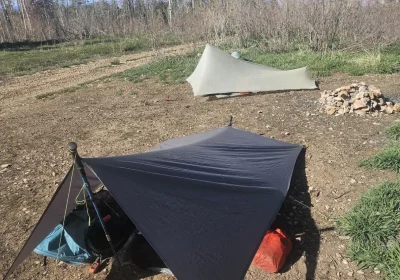
I’ve been a member of r/ultralight for long enough to have spent far too much time reading r/ultralight shakedown posts over my years of backpacking. Every week, hikers link their lighterpack list and ask the community to tear it apart. The advice is usually good for beginners!
Growing wary of near-identical shakedown posts, however, I’ve found myself wondering: what does everyone’s gear look like in aggregate after the changes are allegedly made. Do these shakedowns typically result in more ultralight backpackers out there?
To better answer this question, I analyzed lighterpack URLs from r/ultralight posts across shakedown requests, gear discussions, trip reports, and gear reviews. I successfully fetched 233 lighterpacks, and supplemented them with 88 community reference lists from the r/ultralight wiki, giving 321 in total. Here’s what the data show.
How I Collected the Data
Lighterpack stores gear lists at unique URLs, and the gear data is embedded directly in the page HTML as a URL-encoded JSON object. I pulled post titles and lighterpack links from r/ultralight’s RSS feed, fetched each lighterpack URL, extracted the data, and parsed it into categories and items. Lighterpack stores weights internally in milligrams; I converted everything to grams.
For base weight, I used item-level worn and consumable flags that Lighterpack users set directly on their gear lists. Items marked as worn weight (shoes, hiking clothes on your body) and consumable weight (food, water, fuel) don’t count toward base weight. The median worn weight in this dataset is 1.1 kg / 2.4 lb. Base weight is the standard UL measure: the weight of your shelter, sleep system, pack, and other gear, stripped of what you eat and drink along the way.
Shakedown requests vs. everything else
I classified posts as shakedown requests in two ways: posts using r/ultralight’s official “Shakedown” post flair, and posts with “shakedown” in the title (to catch posts where the author didn’t add flair). Combined, 169 of the 233 scraped lists came from posts seeking shakedown feedback. The other 64 came from trip reports, gear reviews, and general gear discussions. Because these are historic posts (I’m not parsing in real time), I assume that most shakedown posts reflected in the dataset are gear lists that have already been through the gauntlet, and are therefore the end result of an r/ultralight shakedown. Assesing a before and after is beyond the analysis I’m going for in this post.
The two groups are very close in weight. Trip reports and gear reviews skew slightly lighter (41% UL or better vs 30% for shakedown posts), but the median base weight is essentially the same at 11.6 lb for both. Shakedown posts have more Traditional-tier lists at the heavy end, which makes sense since people post for feedback specifically when they know they’re carrying too much and looking to improve.
Most r/ultralight Members Posting Lighter Pack Lists Aren’t Actually Ultralight, but They’re Close!
“Ultralight” is traditionally defined as a base weight under 10 lb (4.5 kg). The median pack in this dataset was 11.6 lb (5.2 kg).
The 10 lb / 4.5 kg ultralight threshold has been the community standard since at least the early 2000s. Super-ultralight (SUL) is generally under 5 lb / 2.3 kg.
Here’s the tier breakdown for the 233 scraped r/ultralight posts:
The interquartile range runs from 9.2 lb (4.2 kg) to 14.2 lb (6.4 kg). 77 of 233 scraped lists (33.0%) meet the 10 lb / 4.5 kg ultralight threshold. About 4 percent would be called “traditional” by any strict definition. So while most folks aren’t actually ultralight after a shakedown, they’re pretty darn close!
Aside: there’s definitely some items missing in the lighterpack lists posted, as you’ll see in the data discussion below based on the number of lists that seem to be missing items I would expect to actually exist when on trail (e.g toothbrushes).
A comparison: the community’s reference lists
The r/ultralight wiki maintains a separate collection of 125 gear lists that community members submitted as examples. The wiki gear lists showcase what UL looks like “in practice”. I fetched 88 of those 125 lists and compared them against the scraped dataset (37 are private or deleted, returning errors when trying to retrieve)
The wiki lists are 1.4 kg (3.0 lb) lighter at the median and 66% reach the ultralight threshold, compared to 33% in the scraped dataset. The gap between “community’s aspirational reference” and “community’s actual shakedown list” is about 3 lb (1.4 kg). Category-by-category, the wiki lists run lighter across the board: pack median 668g (23.6 oz) vs 790g (27.9 oz) in scraped posts, cooking 208g (7.3 oz) vs 293g (10.3 oz), electronics 296g (10.4 oz) vs 423g (14.9 oz).
Ultralight Gear Benchmarks for each Category
For analysis purposes and to give folks targets to help reduce their base weights, I’ve created a “benchmark weight” for each category.
For each category, I looked at what an experienced UL packer can reasonably achieve using quality commercial gear, without going into DIY or “exotic” material territory. The targets are “doable UL,” not super-ultralight if you try hard enough. Someone at exactly the benchmark is doing well. Someone significantly heavier than the benchmark has something worth looking at. These benchmarks are not gospel, but I feel provide a reasonable reference point of comparison for the community.
I cross-referenced my numbers against published pack lists and the general consensus that floats around r/ultralight. My estimates are also informed by my own gear choices over ~17,000+ miles of backpacking. These targets assume 3-season conditions in temperate environments. Winter camping requires a heavier sleep system, of course.
Shelter
600 g / 1.3 lb (21.2 oz)
Zpacks Duplex 2-person trekking-pole shelter: 504g / 18.0 oz body weight. Add 6-8 ultralight titanium shepherd’s hook stakes (40-80g / 1.4-2.8 oz) for a staked total of ~600g. Solo shelters (Plexamid, Lunar Solo, Gatewood Cape), not to mention tarps, can come in well under this.
70.0% of lists exceed this
Sleep system
900 g / 2.0 lb (31.7 oz)
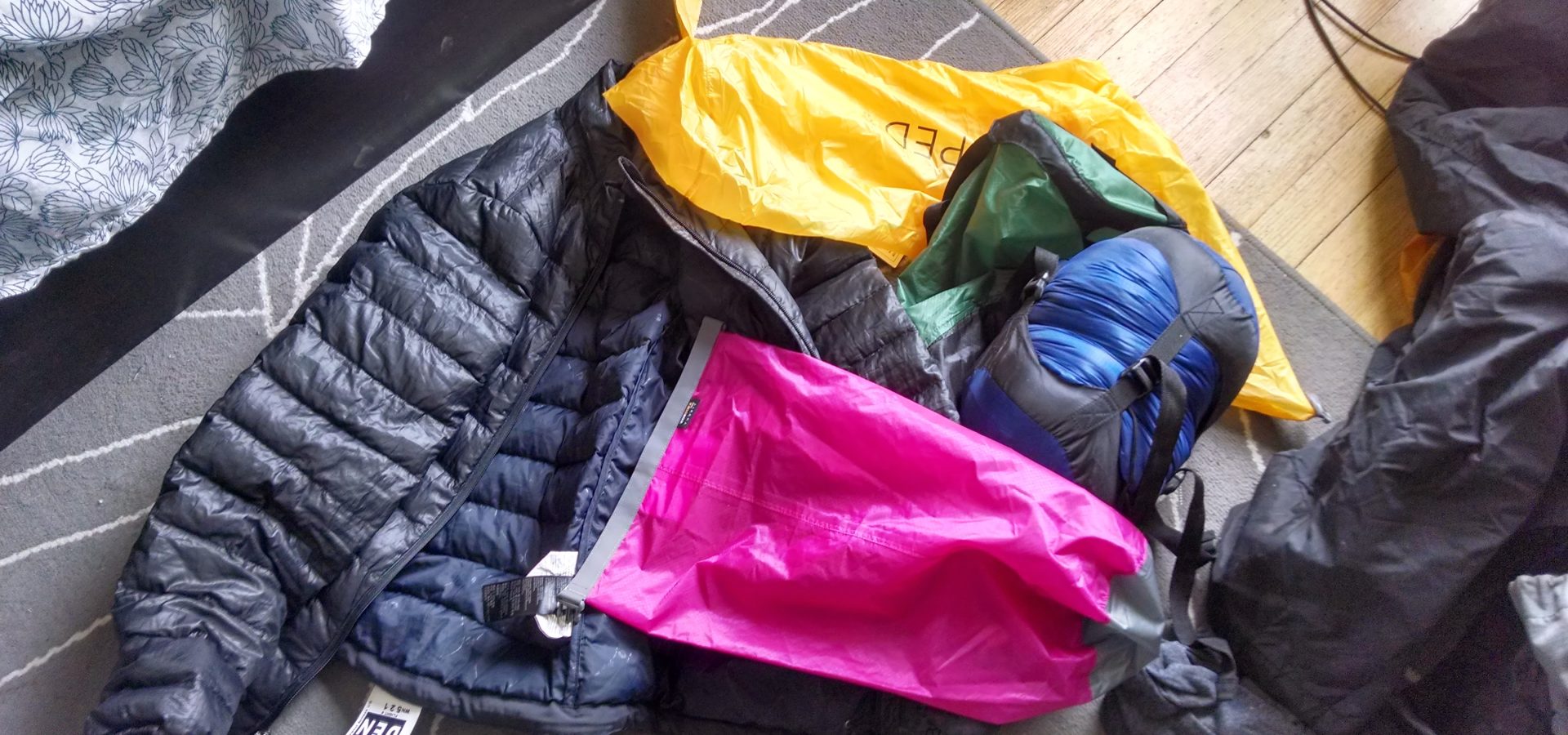
Quilt + pad together. A Katabatic Flex 22 quilt (~650g / 23 oz) + NeoAir XLite or Nemo Tensor pad (~350g / 12 to 13 oz) comes in at ~1,000g / 35 oz. Lighter quilts (EE Revelation ~595g / 21 oz) + a foam pad (~177g / 6 oz) can get under 800g / 28 oz.
69.8% of lists with sleep data exceed this
Pack
800 g / 1.8 lb (28.2 oz)
Hyperlite Junction (816g / 28.8 oz), Gossamer Gear Gorilla (905g / 31.9 oz), Zpacks Arc Haul Ultra (597g / 21.1 oz). This is the category where r/ultralight actually does well.
49.2% of lists exceed this
Clothing + Insulation + Rain
650 g / 1.4 lb (22.9 oz)
Packed only, not worn. Extra socks (~70g) + rain jacket or wind layer (~185g) + insulation piece (~240g) + hat and gloves (~70g) + buff (~35g). Tight but achievable.
50.7% of lists with clothing data exceed this
Cooking (and Water)
300 g / 0.66 lb (10.6 oz)
A canister stove + 750ml Ti pot + spork + fuel canister lands right around here. The BRS-3000T (25g / 0.9 oz) + Toaks Ti pot is the classic ultralight canister setup. But cold-soaking eliminates the stove entirely! Sawyer Squeeze (100g / 3.5 oz) + 2 SmartWater 1L bottles (36g each = 72g / 2.5 oz total) = 172g / 6.1 oz. That’s the most common water setup on trail.
48.8% of lists with cooking data exceed this
Electronics
450 g / 1.0 lb (15.9 oz)
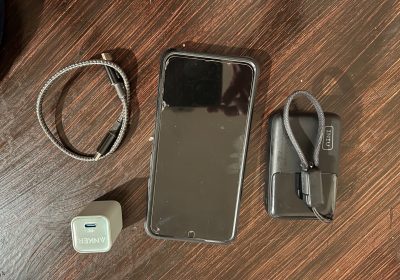
Phone (~200g / 7.1 oz) + Nitecore NU20 headlamp (40g / 1.4 oz) + INIU Mini powerbank (156g / 5.5 oz) + Anker Nano charger (40g / 1.4 oz) + cable (~15g) = ~451g / 15.9 oz. This is a lean but functional kit.
45.1% of lists with electronics data exceed this
Hygiene
100 g / 0.22 lb (3.5 oz)
Toothbrush (14g) + toothpaste (15g) + trowel (25g) + minimal first aid (40g). This one is genuinely achievable for most trips.
77.0% of lists with hygiene data exceed this
The electronics benchmark warrants a specific callout, especially because my benchmark is significantly higher than the r/ultralight wiki median. Maybe this reflects my own bias, but a “lean” electronics kit is typically something like: a phone, plus a Nitecore NU20 headlamp, plus an INIU Mini powerbank, plus a compact charger and cable. That comes to about 450g (~1 lb) before you consider adding a satellite communicator. Obviously for weekend trips, a power bank may be overkill. A modern smartphone alone weighs 170-230g (6.0-8.1 oz). I set the benchmark at 450g (1 lb) rather than a lower aspirational number, which gives wiggle room.
Community median vs. UL benchmark by category. Gray line = benchmark target; blue line = wiki reference-pack median (88 curated lists, median 8.7 lb). Scale: 0 to 1,300g.
More than 50% over benchmark
Up to 50% over benchmark
At or under benchmark
Wiki reference-pack median (8.7 lb)
Benchmark target
Why don’t the category bars sum to the 11.6 lb overall? Two reasons. First, the bars are independent medians (the median shelter weight isn’t necessarily from the same list as the median sleep weight). Second, 86% of scraped posts carry gear that didn’t classify cleanly into one of the 8 main categories such as maps, microspikes, pocket knives, trekking poles, repair kits. That “other” gear has a median of ~578g (20.4 oz) per list, which accounts for most of the gap.
Category by Category: Where the Weight Lives
Clothing, Insulation, and Rain Gear
Median: 666g / 1.5 lb (23.5 oz) · Benchmark: 650g / 1.4 lb (22.9 oz)
Splitting out gear from the lists is non-trivial, but I created a variety of parsing algorithms to break up, categorize, and group gear. Ugh it was annoying! Most folks bundle their puffy, fleece, and rain layer into a clothing category. That means the clothing total includes insulation as well as wind and rain gear and any other packed clothes.
Second: worn weight. Shoes averaging 338g (11.9 oz) — obviously a lone peak bias — show up in clothing categories across the dataset, as do hiking shirts, shorts, and the base layers that people are wearing. I excluded worn weight using the worn-weight tag in lighterpack. As such, the benchmark above is for packed clothing only.
Breaking down packed clothing items (worn-weight excluded) across the 233 scraped r/ultralight posts. The most-worn item by far is extra socks. For legwear, I have a separate breakdown of convertible hiking pants tested over 15,000+ miles if you want field data rather than community consensus.
- Extra socks — in 200 of 233 scraped lists (85.8%), the most universally carried clothing item. Median packed weight: 55g / 1.9 oz per pair. Darn Tough is the most common brand, appearing in 80 scraped lists (34.3%). Injinji liner socks appear in 19 scraped lists (8.2%).
- Rain and wind layers — rain jackets in 149 scraped lists (63.9%). Median rain jacket weight: 178g / 6.3 oz. Montbell rain and wind gear appears in 45 scraped lists (19.3%). Frogg Toggs appears in 45 scraped lists (19.3%).
- Insulation layers — 175 scraped lists (75.1%) carry a packed insulation piece. Down/puffy jackets median 280g / 9.9 oz; fleece layers median 130g / 4.6 oz. Enlightened Equipment Insulation (Torrid jacket) appears in 15 scraped lists (6.4%).
- Hats and gloves — hats in 92 scraped lists (39.5%), gloves in 96 scraped lists (41.2%).
- Pants (packed) — in 130 scraped lists (55.8%), median 113g / 4.0 oz. Highly variable.
Obviously, nothing is too egregious here, but many of the lists are carrying additional, superfluous layers that can be significantly reduced (e.g. alpha direct and a puffy).
Electronics
Median: 423g / 0.93 lb (14.9 oz) · Benchmark: 450g / 1.0 lb (15.9 oz)
45.1% of lists exceed 450g (16 oz) in electronics, and the community median of 423g (15 oz) actually sits under the benchmark. I think the days of paper map and compass navigation are gone, so the biggest weight savings is from right-sizing a power bank for your trip (e.g. leave it at home, or drop down to 5000 mAh). On long western trails where sun is reliable, a solar panel can replace the power bank entirely.
A lean but functional kit: phone (~200g / 7.1 oz) + Nitecore Nu25 headlamp (42g / 1.5 oz) + INIU Mini powerbank (156g / 5.5 oz) + Anker Nano charger (40g / 1.4 oz) + cable (~15g / 0.5 oz). That’s already 450g (16 oz) before you add a satellite communicator, camera, or earbuds. A Garmin inReach Mini adds another 100g (3.5 oz), roughly 20% of this category’s total on its own.
Sleep system
Dataset median: 1.1 kg / 2.5 lb (40.0 oz) · Benchmark: 900g / 2.0 lb (31.7 oz)
The sleep system benchmark covers both the quilt or bag and the sleeping pad. Looking at the actual weights from the 233 lists: quilts have a median of 607g (21.4 oz) and sleeping pads a median of 369g (13.0 oz), for a combined category median of ~1,123g (39.6 oz). Many lists also include a pillow, a bivy, a liner, or other sleep accessories in this category. Sleeping bags have a median of 756g (26.7 oz) in the scraped dataset.
A Katabatic Flex 22 quilt runs about 650g (23 oz) for a regular length. A NeoAir XLite or Nemo Tensor pad sits around 350g (12.4 oz). Together that’s ~1,000g (35.3 oz). You can get under 900g with a lighter quilt (the EE Revelation runs about 595g / 21 oz in the dataset) paired with a foam pad (~177g / 6.2 oz) — but you give up the pad’s packability and warmth. The 900g benchmark is real but tight.
Shelter
Median: 850g / 1.9 lb (30.0 oz) · Benchmark: 600g / 1.3 lb (21.2 oz)
70.0% of lists exceed the shelter benchmark, with a median of 850g (30.0 oz). The 600g (21.2 oz / 1.3 lb) benchmark is anchored to the Zpacks Duplex: a 2-person trekking-pole shelter, the standard for a capable ultralight 2-person setup. Solo shelters like the Plexamid or Lunar Solo can come in under 500g with stakes included. Freestanding tents, which are easier to pitch in varied terrain, typically weigh 1.2-2.0 kg / 2.6-4.4 lb (42-70 oz). The benchmark just shows what is available if you go non-freestanding. And of course it can be even lighter with a tarp and bivy setup (my preference and choice for solo trips).
Most common specific shelters: Durston X-Mid (1P and 2P combined), 65 lists (27.9%). MSR Groundhog stakes, 47 lists (20.2%), which is nearly as common, since most X-Mid users stake with Groundhogs. Polycro groundsheet, 28 lists (12.0%). Zpacks Plex Solo, 19 lists (8.2%). Lanshan 1 Pro, 13 lists (5.6%). The X-Mid leads, but most remaining shelters are too varied to dominate.
Pack
Median: 790g / 1.7 lb (27.9 oz) · Benchmark: 800g / 1.8 lb (28.2 oz)
The one bright spot. The community median of 790g (27.9 oz) sits just under the 800g (28.2 oz) benchmark I provided. 49.2% of lists exceed it, but the median suggests r/ultralight has largely made the switch to frameless or semi-frameless packs. I guess the allure of super light packs is much more appealing than tarp camping for most folks?
Brand notes: Many brand names that do appear: Durston Kakwa (31 lists), Palante (4 lists), Osprey Atom or Exos (3 lists), Zpacks Nero (2 lists). Based on item weights, packs in the 500-700g range are most common, pointing to Gossamer Gear Mariposa, Zpacks Arc Haul, and HMG packs as the likely dominant options.
Of note, frameless packs are typically going to only be ergonomically comfortable when your base weight is genuinely low. If total base weight is above 5.4-6.4 kg (12-14 lb), or ~20 lbs fully loaded, some kind of frame or framesheet becomes important, which adds weight back in. The pack and the rest of the list have to be designed together.
Cooking
Median: 293g / 0.65 lb (10.3 oz) · Benchmark: 300g / 0.66 lb (10.6 oz)
48.8% of lists exceed the 300g cooking benchmark, and the community median of 293g (10.3 oz) is under it. The benchmark assumes a minimal canister setup, like a BRS-3000T (25g / 0.9 oz) or similar ultralight stove, a TOAKS titanium pot, a BIC Mini lighter, and a long-handle spoon. Add a Sawyer Squeeze and SmartWater bottles and you’re already at the benchmark. The median is higher because many people carry more pot volume, a windscreen, fuel canisters, and additional containers. My personal preference is going no cook and using a Telenti jar =)
Most common specific cooking & water gear (233 scraped lists): BIC Mini lighter, 120 lists (51.5%) — the most widely carried item. SmartWater 1L bottle (dirty-water carry or clean-water backup), 103 lists (44.2%). Sawyer Squeeze, 70 lists (30.0%). TOAKS titanium pot (750ml), 56 lists (24.0%). Platypus Quickdraw, 50 lists (21.5%). BRS-3000T stove, 48 lists (20.6%). TOAKS titanium long-handle spoon, 48 lists (20.6%). Katadyn BeFree, 25 lists (10.7%). MSR Pocket Rocket 2, 23 lists (9.9%).
The wiki reference lists have a median of 208g (7.3 oz) for cooking, vs 293g across the 233 scraped posts. The difference likely reflects more cold-soakers in the curated reference lists.
Hygiene, First Aid, and Sanitation
Median: 179g / 0.39 lb (6.3 oz) · Benchmark: 100g / 0.22 lb (3.5 oz)
77.0% of lists exceed the 100g hygiene benchmark. The median of 179g (6.3 oz) suggests most people carry more than a toothbrush and trowel. First aid kits appear in 129 scraped lists (55.4%), often as a single kit weight rather than individual items, and are the single largest contributor to hygiene weight after the bidet.
Most common specific hygiene gear (233 scraped lists): Toothbrush, 169 lists (72.5%) — the most universally packed hygiene item, although the 64 lists without suggests that people just don’t list all their items. Toothpaste, 154 lists (66.1%). Deuce of Spades trowel, 133 lists (57.1%). First aid kit, 129 lists (55.4%). Sunscreen, 120 lists (51.5%). Bidet (CuloClean or similar), 96 lists (41.2%). Leukotape, 68 lists (29.2%). Hand sanitizer, 60 lists (25.8%).
Using This for Your Own Shakedown
The benchmark system is most useful as a diagnostic, not a target. If your sleep system is at 1.5 kg (3.3 lb) and the benchmark is 700g (1.5 lb), that tells you there’s 800g (1.8 lb) of theoretical weight reduction opportunity, even if the right answer for your specific trip is somewhere in between.
Sleep system first. Among the 233 scraped lists, 50% have a quilt and 28% a sleeping bag, so r/ultralight has broadly adopted the quilt transition. The pad is where more room remains: specific air pad (NeoAir, Tensor) or foam pad mentions appear in about 43% of lists; the other 57% use generic “sleeping pad” entries where I couldn’t readily parse out the type. Moving to a quilt saves 200-400g (7.1-14.1 oz) over a comparable mummy bag; moving from a heavy mat to a lightweight inflatable saves a similar amount.
Clothing and insulation second. The key is treating clothing as a system rather than a collection of items, and committing to one insulation piece rather than carrying multiple warmth layers. A useful exercise after any trip: what came out of your pack unused? That list is usually a better shakedown tool than any weight target.
Electronics: harder than it looks. A minimal real-world kit (phone, small headlamp, small powerbank, cords, charger) already runs about 450g (~ 1 lb). Cuts below that require either consolidating safety devices onto the phone or accepting less redundancy. The highest-leverage move is usually right-sizing/dropping the power bank.
The Gear That Actually Shows Up
Based on item-level analysis of the 233 scraped lighterpack lists, these are the products that appear most often. Counts show unique scraped lists carrying that item, not total mentions.
This section contains affiliate links. If you buy through them I may earn a small commission at no extra cost to you.
Sleep System
Sea to Summit Aeros Premium Pillow39 lists · 16.7%
Nemo Fillo Elite Pillow19 lists · 8.2%
EE Revelation quilt18 lists · 7.7%
EE Enigma quilt10 lists · 4.3%
Clothing & Footwear
Altra Lone Peak39 lists · 16.7%
Frogg Toggs Rain Jacket45 lists · 19.3%
Buff Multifunctional Headwear57 lists · 24.5%
Cooking & Water
Sawyer Squeeze Water Filter70 lists · 30.0%
SmartWater 1L Bottle103 lists · 44.2%
TOAKS Titanium 750ml Pot56 lists · 24.0%
BRS-3000T Ultralight Stove48 lists · 20.6%
TOAKS Long Handle Titanium Spoon48 lists · 20.6%
MSR Pocket Rocket 223 lists · 9.9%
Platypus Quickdraw Filter50 lists · 21.5%
Katadyn BeFree25 lists · 10.7%
Electronics
Garmin inReach Mini 281 lists · 34.8%
Nitecore NB10000 Power Bank30 lists · 12.9%
INIU 10,000 mAh Power Bank38 lists · 16.3%
Hygiene & First Aid
CuloClean Portable Bidet96 lists · 41.2%
Sunscreen SPF 50+120 lists · 51.5%
Leukotape P68 lists · 29.2%
CSV with post title, date, author, source, total weight, base weight, and tier for each list. 321 rows.
A Few Caveats
This dataset skews toward active posters who are seeking feedback, which is not a random sample of the backpacking population or even of r/ultralight members as a whole. Heavier lists may be slightly over-represented (people post shakedowns when they know they need help) or under-represented (experienced light packers rarely post shakedowns because they don’t need them).
Category mapping from lighterpack’s free-form category names to standardized buckets is done by keyword matching, and it’s imperfect. An item labeled “layers” by one hiker and “insulation” by another may land in different categories. I used AI to help do line-item matching and categorization, before moving to k-means clustering and a few other manual tasks, as the AI is genuinely somehow terrible at this.
The dataset covers posts from roughly 2025-2026. Gear keeps getting lighter, so benchmarks set against today’s options may need updating as better choices hit the market.
Raw data: 233 lighterpack.com gear lists scraped from r/ultralight posts + 88 community reference lists from the r/ultralight wiki = 321 total, fetched August 2026. Of the 125 wiki lists, 37 returned 400 errors (private or deleted). Gear brand reference: r/ultralight crowd-sourced gear database (383 entries).